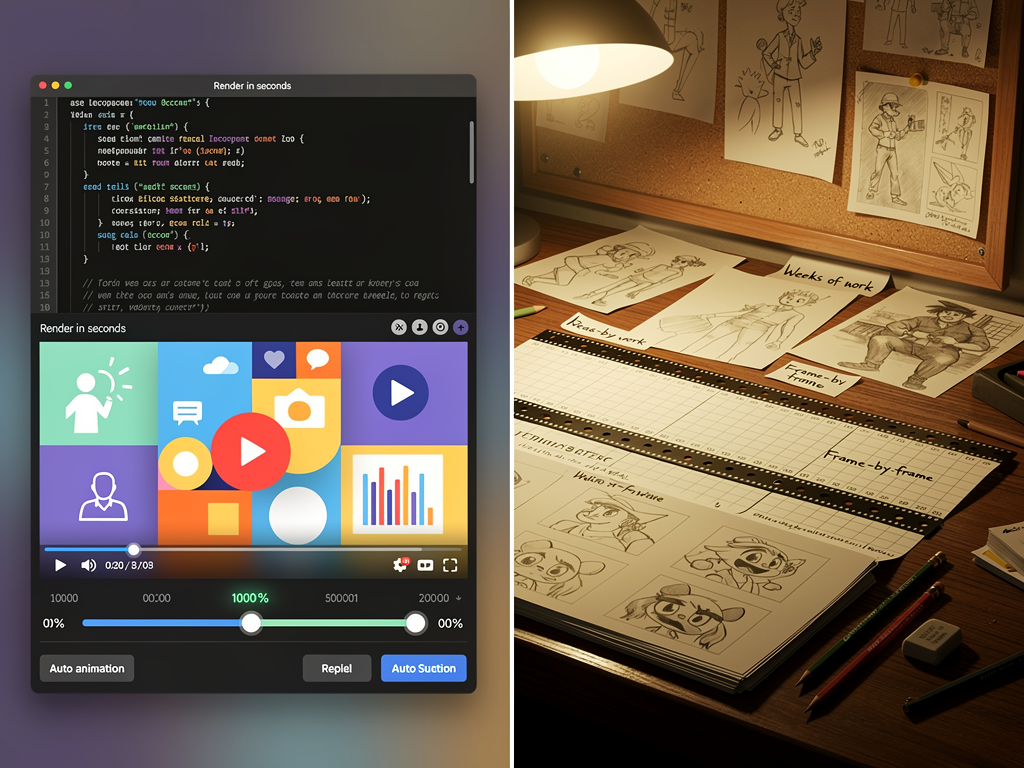
AI video generators create finished animations in minutes by interpreting a script or image and auto-generating scenes, timing, and narration. Traditional animation requires a team of artists, storyboard designers, and animators working over weeks or months to hand-draw or model every frame. The core difference is automation versus craft: AI trades artistic control and polish for speed and affordability.
Both have their place. If you need an explainer video by Friday, AI is the only realistic option. If you're building a brand identity that demands a specific visual style or you're creating content for a theatrical release, traditional animation gives you that control—but at a cost measured in thousands of dollars and months of lead time.
How does AI video generation actually work?
AI video tools take your input—a topic, a script, a PDF, or a reference image—and use machine learning to generate a sequence of scenes that match the narrative. The system interprets the text semantically, decides what visual elements would illustrate each idea, times the animations to the narration, and renders the whole thing as a finished video.
Unlike traditional animation, where an artist sits down and draws or models each frame, AI video is generative: it synthesizes scenes from learned patterns in visual design, typography, and motion. You don't draw anything yourself. You write or upload, and the AI handles the rest—including text-to-speech narration in multiple languages.
The trade-off is predictability. AI video tends toward a recognizable visual style (whiteboard animations, flat design, simple motion graphics) because that's what the training data emphasizes. You get consistency and speed, but less uniqueness. Traditional animation, by contrast, can look however the artist wants it to look—which is why it's still the standard for branded content, feature films, and anything where visual distinctiveness matters.
What's the speed difference between AI and traditional animation?
AI video: 5–30 minutes from input to finished render.
Traditional animation: 4–12 weeks, depending on length, complexity, and team size.
For a 2-minute explainer video, a traditional animation studio typically quotes 6–8 weeks. That includes concept art, storyboarding, voice recording, animation, and revisions. An AI tool like Ankon AI produces the same length in under an hour—often much faster if you use a pre-written script.
The speed advantage of AI is not marginal; it's transformative for anyone working on a deadline. Product launches, internal training, educational content, and marketing campaigns all benefit from being able to iterate and ship in a single day instead of waiting two months.
Traditional animation's timeline isn't a bug—it's a feature for projects where quality and artistic vision are non-negotiable. But for most business and educational use cases, the speed of AI is a decisive advantage.
How much does each approach cost?
AI video typically costs $0–$300 per video depending on the tool and plan:
- Free tier: $0 (limited features, watermark)
- Starter subscription: $29/month for 15 credits (roughly 7–8 videos at base rate)
- Plus: $69/month for 40 credits
- Pro: $119/month for 75 credits
- Studio: $249/month for 160 credits
At the Starter tier, your cost per video averages $4–$6. At the Plus tier, it's $1.70–$2.10 per video. One-off top-ups are $2 per credit ($10 minimum).
Traditional animation costs $2,000–$15,000+ per finished minute, depending on studio reputation, animation style, and revision rounds. A 2-minute explainer video from a mid-tier studio runs $4,000–$8,000. A 5-minute video can easily hit $15,000–$25,000. High-end studios charge $20,000–$50,000+ per minute.
The cost difference is stark. For the price of one traditional animation, you can generate 50–100 AI videos.
What about quality and visual polish?
AI video quality has improved dramatically. Modern AI tools produce clean, professional-looking animations with smooth motion, readable typography, and well-timed narration. For explainer videos, product demos, and educational content, AI output is indistinguishable from entry-level professional animation to most viewers.
Where AI falls short:
- Artistic uniqueness: AI animations follow learned patterns. You get a recognizable "AI style" (often whiteboard or flat design). Traditional animation can be anything—3D, hand-drawn, stop-motion, photorealistic—and it's custom to your brand.
- Complex motion: AI struggles with intricate character animation, detailed interactions, or highly stylized movement. Traditional animation handles these naturally.
- Revisions and custom requests: If you want to change the color scheme, redraw a character, or adjust pacing frame-by-frame, traditional animation is flexible. AI video regenerates from scratch, which can work but isn't as surgical.
- Brand consistency across projects: If you're building a visual identity, traditional animation lets you lock in a specific look across multiple videos. AI tools tend toward their default aesthetic.
For most business and educational videos, AI quality is sufficient and often excellent. For branded content, campaigns, or anything where visual distinctiveness is a competitive advantage, traditional animation still wins.
When should you choose AI video?
Choose AI video if:
- You're on a tight deadline: Days or hours, not weeks.
- Budget is constrained: You need video content but can't spend $5,000–$20,000 per video.
- You need volume: Generating 10 or 20 videos in a month is practical with AI; it's prohibitively expensive with traditional animation.
- The content is educational or explanatory: Whiteboard and flat-design animations are ideal for teaching concepts, explaining processes, or walking through software.
- You're iterating: You want to test messaging, tweak scripts, and produce variations quickly.
- You don't need a bespoke visual identity: You're comfortable with a clean, professional default style.
Common use cases: internal training, product explainers, educational content, marketing funnels, SaaS demos, onboarding videos, and social media clips.
When should you choose traditional animation?
Choose traditional animation if:
- Visual distinctiveness is critical: Your brand or message demands a custom look that sets you apart.
- You're investing in long-term content: A hero video for a product launch, a brand film, or a campaign that will run for years justifies the upfront cost and time.
- You need character-driven storytelling: Complex character animation, facial expressions, and nuanced movement are traditional animation's strength.
- You want full creative control: You have a specific vision and need an artist to realize it exactly.
- The project is high-stakes: Feature films, theatrical releases, or premium brand content benefit from the polish and craftsmanship of traditional animation.
- You're building a visual language: If you're creating multiple videos and need consistency across a custom aesthetic, traditional animation locks that in.
Common use cases: brand films, feature animations, premium advertising, theatrical content, and high-visibility campaigns.
Can you combine AI and traditional animation?
Yes. Many studios now use AI video as a rapid prototyping or storyboarding tool, then hand off to traditional animators for refinement and polish. You might generate an AI explainer video to test messaging, then commission a traditional animator to recreate key scenes in a custom style.
Another hybrid approach: use AI video for the bulk of your content (fast, cheap, scalable) and reserve traditional animation for hero content or brand-defining pieces. This balances speed and cost with occasional high-impact visual distinctiveness.
What's the learning curve?
AI video tools are designed for non-animators. You don't need to know animation, design, or video editing. You write a script or upload a document, click generate, and the tool handles the rest. Most people produce their first video in under an hour.
Traditional animation requires hiring an animator or learning animation software (Blender, After Effects, Toon Boom) over months or years. The barrier to entry is much higher.
For anyone without animation skills, AI video is the only practical option. For professional animators, AI is a productivity tool, not a replacement—it handles the tedious parts and frees them to focus on creative direction and polish.
What about AI video limitations?
AI video tools have real constraints:
- Factual accuracy: AI can hallucinate or misinterpret complex information. Some tools (like Ankon AI) offer a fact-check feature that independently verifies the script, but it's an add-on, not automatic.
- Customization: You can't easily tweak individual scenes or adjust animation timing frame-by-frame. You regenerate or accept the default.
- Niche styles: If you need a specific animation style (stop-motion, hand-drawn, 3D photorealism), AI tools won't deliver it. They're optimized for explainer and whiteboard aesthetics.
- Long-form content: AI video works best for 2–5 minute videos. Longer content can feel repetitive because the visual vocabulary is limited.
- Voiceover quality: AI text-to-speech is good but not perfect. Accents, emphasis, and emotional delivery are still better with human voice talent.
These aren't deal-breakers for most use cases, but they're worth knowing.
The verdict: AI video is the default, traditional animation is the exception.
If you need video content and you're not a professional animator or a major brand with a seven-figure budget, AI video is the practical choice. It's fast, affordable, and the quality is professional. You can generate dozens of videos in the time it takes to brief a traditional animator.
Traditional animation remains the gold standard for branded, high-visibility, or artistically ambitious content. But for the vast majority of business, educational, and marketing videos, AI has already won on speed and cost. The question is no longer "Should I use AI video?" but "When do I need traditional animation instead?"
For most teams, the answer is: rarely. Use AI video for your regular content pipeline, and reserve traditional animation for the occasional hero project where visual distinctiveness is worth the investment.
Ready to try AI video? Ankon AI offers 2 free credits on signup—enough to test a short explainer or product demo with no card required.